The History of ‘A Simple Gesture’
It started in Ashland, Oregon
Around 2010 John Javna, a best selling author and a committed humanitarian developed the idea of building a better community. His idea was to get neighborhoods in Ashland, OR to band together and share their excess food with others that needed the help. He came up with the idea of using a highly visible green bag. His vision was to accomplish two things;
- to get more food to those that need it, and
- bring communities closer together by working on problems together.
This simple yet powerful idea quickly took off. Today Ashland's program has the highest 'density' of any Home Food Donation Program in the country; about 30% of households participate! Bend Oregon isn't far behind.
The great thing about the Neighborhood Food Project model is how they are built around Neighborhood Coordinators. Their system is more 'people working with people' as the Neighborhood Coordinator activates her neighbors, collects the food, and delivers it to pantries.

A Simple Gesture starts!
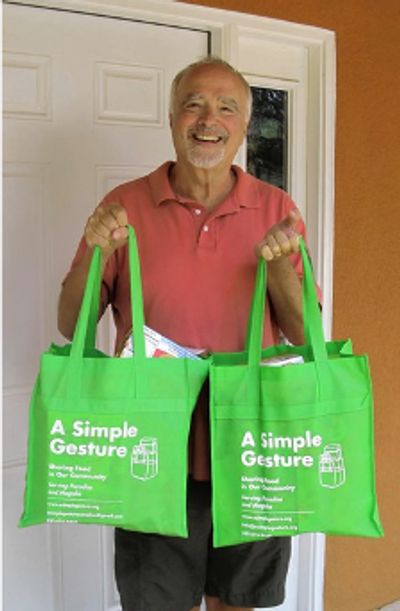
About a year after Neighborhood Food Project started in Ashland, the father of one their board members was visiting from Paradise, CA. This gentleman, Jonathan Trivers, liked the idea so much he decided to start his own chapter in Paradise, CA. He made a few tweaks to the format and called it “A Simple Gesture”.
The main difference for "A Simple Gesture" was to work community wide, allowing anyone to register. They then arranged for drivers to pick up the food rather than the Neighborhood Food Project.
It could be debated which model was better, but the amount of food being collected would say it is a tie. Both programs worked very well.
2025: add in tech
Mark Martindill, living in Santa Rosa, CA, spent part of his retirement working with local non-profits to improve their systems and workflows. His background was a mix of tech and efficiency.
The areas food bank asked him to look into recurring home food pick up solutions. Soon after Mark was talking to the Greensboro "A Simple Gesture" chapter along with many others. He was able to identify 115 active chapters, and gathered data and background from around 40 to 50.
It became apparent these programs worked very well. But they only serviced about 1% of the population, 99% of us could not put a bag on our doorstep! It became his mission to change that.
The first conclusion was these programs were too hard to operate. Most chapters were tapped out, barely able to service the program they had in place. A medium sized chapter was spending 40 to 50 hours a month, and larger ones much more. He called this a 'barrier of entry', it prevented other chapters from joining in. It was a perfect opportunity to improve.
He registered "Simple Gesture Systems, Inc" as a 501(c)(3) non profit organization.
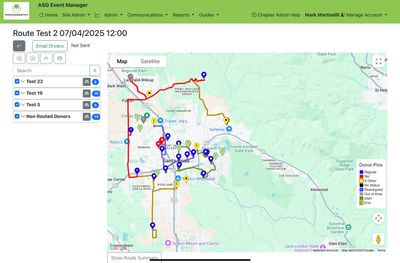
Over the next 16 months he developed the "ASG Web App". A 'do it all' program that used automation, 2 way communication, route optimization, and other methods to handle 95% of the work a chapter administrator was tasked to complete.
This is when the Redwood Credit union stepped in. They were the largest funder for non-profits in the North Bay region covering over 1000 square miles. They learned of the work being done and helped fund and support the program.
In order to test the software, Mark set up 18 active chapters in Marin, Lake, Sonoma, Mendocino and Napa counties. These served to test the software and deliver food to local pantries. They started operation in October '25 and had delivered nearly 150,000 pounds within the first year.
Where are we headed?
The next phase for "A Simple Gesture" is going to be remarkable.
The goals are unbelievable, yet reachable. We have the data to prove it all out.
The ultimate goal is to unite the existing chapters in some way and start up 900 more chapters. The ASG Web App was built to handle hundreds of thousands of donors, even millions.
Mark is working hard to find partner organizations to take the ASG Web App national. In '25 we estimate 4.5 million pounds of food came in through the many chapters spread across the country, yet it only reached 1% of the population. What would happen if 70% or more of the population could participate?
The first goal is 'density', reaching at least 5% of households. This has proven to be doable. More than a dozen current chapters are above 10%. The chapters started by Mark are already around 1% in the 1st year, with one at 2%. Ashland OR is past 30%.
Mark and his team have developed a suite of 'donor development' methods that work They have been tried many times over, and the data is conclusive;
- "Join Your Neighbor", a method to reach out to households adjacent to current donors adds 10% more to the donor base each time its run.
- "Green Apron Project" using paid registration experts and a finely tuned 'ask' message registers 4-6. people per hour per resource. A small implementation in a local area can add 200-300 donors a month for a very small cost.
- "Ask Your Neighbor", another method built into the ASG web app that adds around 6% to the total base each time its run.
- Personal Campaigns; a great way to reward individuals that want to increase the donor base; their personal web page is built into the ASG web app and helps them on-board new donors.
In total, these methods will add 1-2% of households per year, and this is without making it a primary focus. If full effort is made, we believe 10% household participation can be reached in 5 years. (although, we have not had enough time to prove it, check back later!).
The second goal is to open new chapters. We'd like to see 1000 chapters across America, reaching about 70%+ of households.
Combining these two goals yields a result that would move the needle against food insecurity and hunger;
- 450 million pounds of targeted, nutritious food per year.
- Food value exceeding 1 billion dollars.
